FIELD MANUAL // 07
Victory
Elimination, shared victory, scoring, and elimination spoils
Domination Victory
When only one player remains on the map, that player wins outright with the full score. Every other player has been eliminated — their territories conquered, their cards inherited, their agreements voided. This is the default win condition and the most decisive outcome.
Players are eliminated when they lose their last territory. There is no surrender option and no way to re-enter the game once eliminated.

Shared Victory
When exactly 2 players remain and they have an active ceasefire between them, the game ends immediately in a shared victory. No more turns are played — the truce triggers the endgame.
Victory is split by a composite score with three weighted components:
- 50% Territory ownership — percentage of the map you control
- 20% Army size — total troop count across all your territories
- 30% Card hand value — total point value of cards in your hand
Card point values for scoring:
| Card type | T1 | T2 |
|---|---|---|
| Value | 1 point | 2 points |
| Agreement | 2 points | 4 points |
| Standalone | 3 points | 6 points |
The card score is a hidden variable. Hand contents are private, so neither player knows exactly how the score will split until the game ends. You might control more territory but lose on card value — or vice versa. This uncertainty makes the decision to pursue shared victory a gamble in itself.
Shared victory is enabled by default but can be disabled in custom game settings for an elimination-only variant.

The Scoreboard
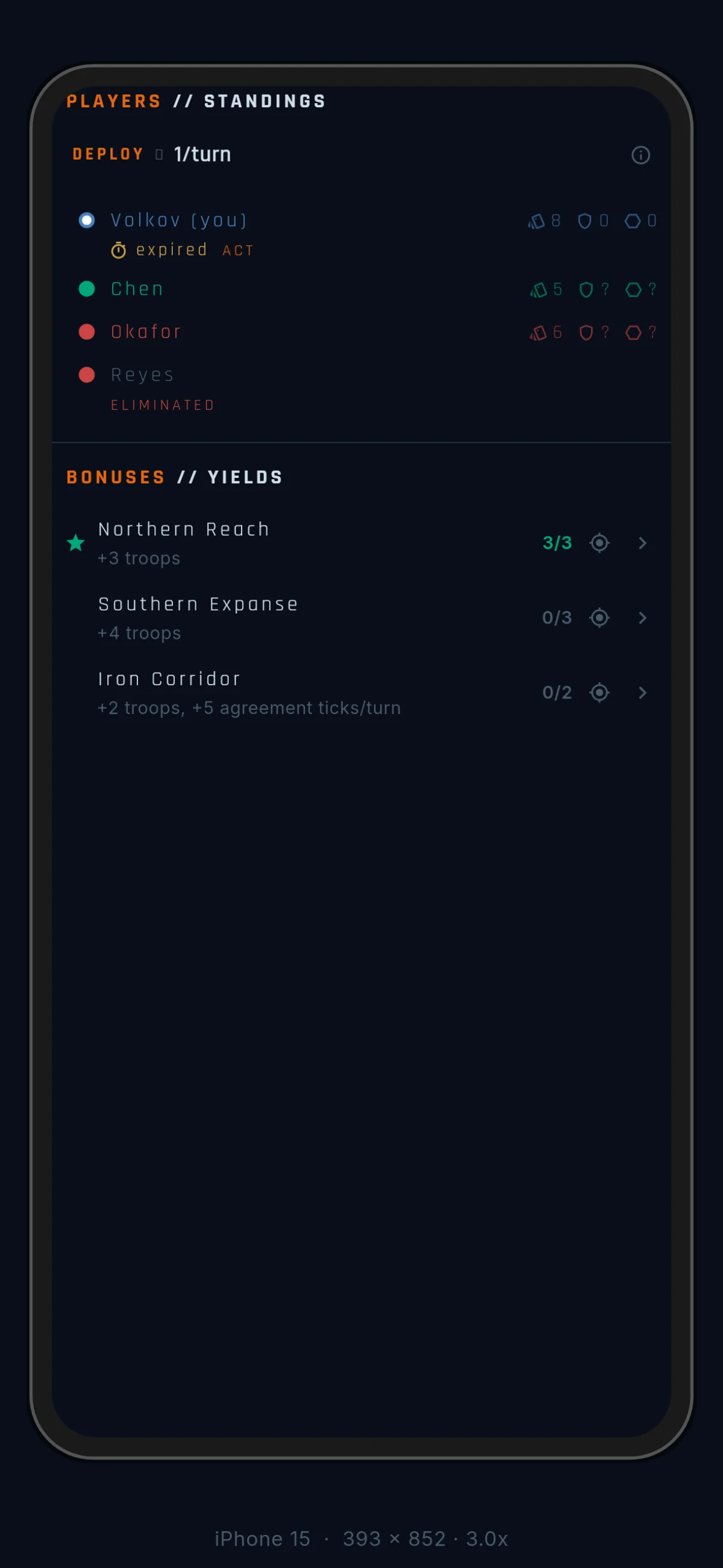
During the game, the scoreboard shows territory counts, troop totals, and publicly known information for each player. It gives you a sense of the balance of power, but not the full picture — card hands are hidden, and fog of war obscures territories you cannot see.
Final scores are calculated only when the game ends. The scoreboard during play is strategic intelligence, not a final ranking.
Elimination Consequences
When a player is eliminated, the consequences ripple through the game:
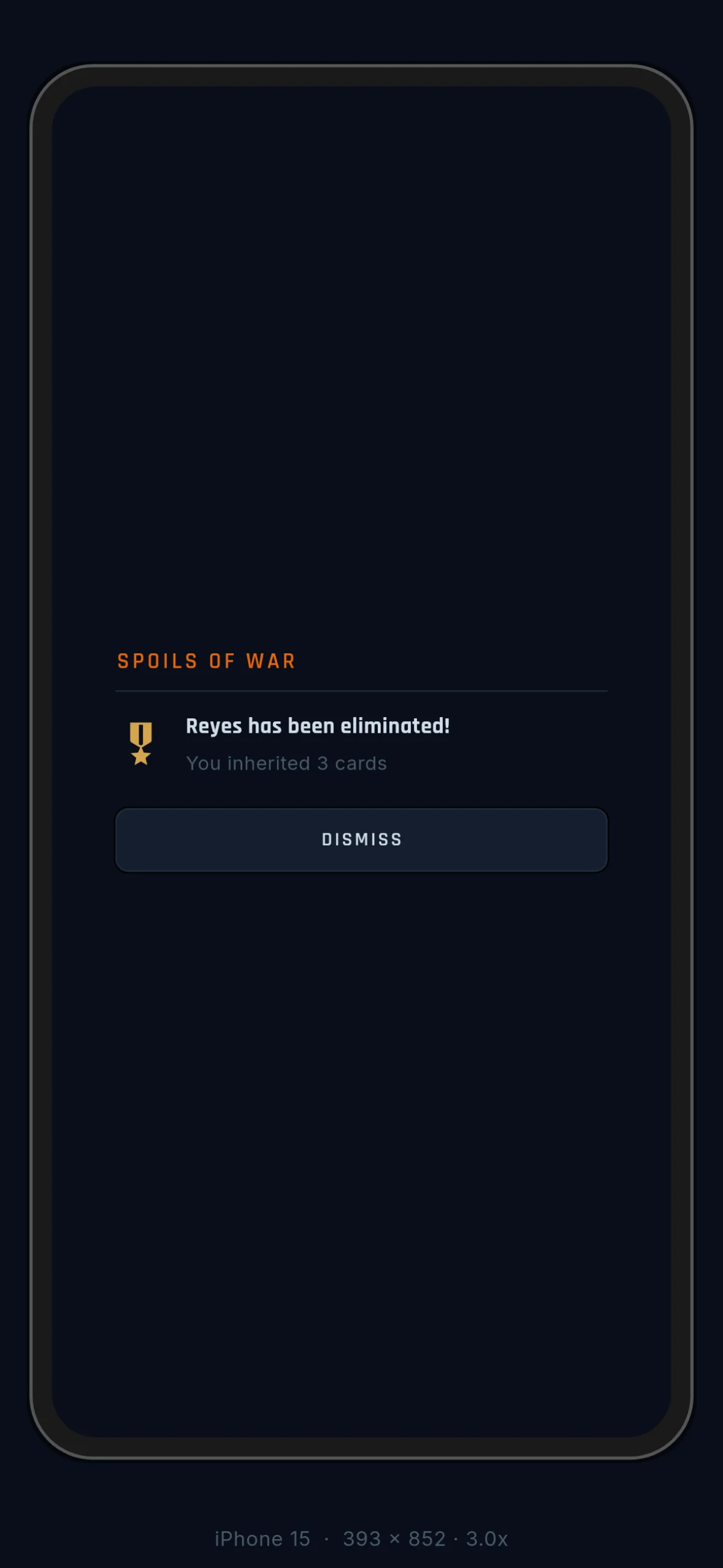
- Card inheritance: The eliminator inherits the eliminated player’s entire card hand. This can be a windfall of high-value cards or a hand-management crisis if it pushes you over the limit.
- Agreement voiding: All of the eliminated player’s active agreements are voided immediately. Ceasefires, manufacturing partnerships, covert support — all dissolved. This can destabilise the entire diplomatic landscape.
- Overflow discard: If the inherited cards push the eliminator above the hand limit, they choose which cards to discard down to the limit.
Eliminating a player is always consequential. The card inheritance alone can swing the balance of power — and the voided agreements can create openings (or crises) for every remaining player.